Variable Rake, Mechanical Or Swing Beam Hydraulic? (A Look At Durma’s Sheet Metal Guillotines)

sheet metal guillotine is a fantastic addition to any metal fabrication workshop – especially when it comes to the premium-grade products from Durma. We’re going to be taking a look at the three Durma guillotines that we have and highlighting their features and differences – so you can have a better idea of which product will suit your applications better.

Different types of guillotines

Before we jump into the product’s specifics – it’s important to note that the core ways in which each of these machines cut is different. The three machines we’re going to be looking at in this blog are variable rake, mechanical and swing beam hydraulic.

  • Variable rake guillotines offer a diverse range of cutting options for all types of thicknesses and cut types. They can offer precise cuts with minimum twisting and are usually the more advanced machines out of the three types.
  • Mechanical guillotines are driven by flywheel clutch-engaged eccentrics. They’re simpler machines that use less power overall and are easier to maintain.
  • Swing beam hydraulic guillotines move in a circular arc motion which can deliver clean, right-angled cuts. They use the energy from hydraulic valves within a manifold to power the motor. This delivers force to a single point during a cut which is then transferred to other points along the cutting line.

VS variable rake hydraulic CNC guillotine

Durma’s VS series hydraulic guillotine utilises state-of-the-art CNC technology to bring you one of the most sophisticated shear machines available on today’s market. Its superior cutting capabilities allow it to take on thicknesses ranging from 6 – 25mm as well as 0° 30′ – 2° precise rake adjustment to be made ensuring a truly fine cut without sacrificing any of the quality.

The VS series sheet metal guillotine comes with a D-Touch 7 control unit to guarantee easy and seamless cuts within seconds thanks to its easily navigable GUI. Durma’s robust back gauge system is proudly featured on this model and works to further ensure fast and precise cuts. An often-overlooked factor, a guillotine’s back gauge system is imperative in not only assuring a stable and precise cut time and time again but also in reducing rattling and improving stability throughout the whole process.

MS mechanical guillotine

Suitable for a variety of types of metal and thicknesses, Durma’s MS mechanical guillotine is the perfect jack of all trades shear machine. Enjoy efficient, precise cuts with modern safety capabilities that go above and beyond – once again establishing Durma as a leader when it comes to sheet metal machinery safety. You can also enjoy low power consumption and direct drive technology to optimise your day-to-day activities.

If you don’t need a guillotine for any one specific use then this MS series machine is your best bet as it’s an efficient, accurate and economical device capable of incredible, high-quality cuts. It’s also equipped with Durma’s specialised magnet brakes and clutch system which ensures your operating cycles run at high torques and that you can enjoy a backlash-free experience.

SBT swing beam guillotine

The SBT swing beam guillotine from Durma is already capable of delivering high-precision cuts thanks to the blade’s arc motion – but this is further improved by Durma’s high tech innovations that guarantee this at a low-cost. The rigidly built exterior is built to last and ensure smooth operations. One of the biggest features of this sheet metal guillotine is the reduced cutting angle – which allows the user to achieve straighter precision with minimum twist tolerance.

The SBT (as well as the previous two machines) includes light curtains for finger guards as well as an adjustable angle stop from 0 – 180°. This machine also features a blade gap adjustment and sheet support systems for faster and more reliable continuous cuts.

Are you in the market for a sheet metal guillotine?

The three sheet metal guillotines mentioned above are all premium shear machines that will deliver precise and clean cuts for a variety of situations and are all made by the veteran sheet metal machine manufacturer Durma. ACRA Machinery is a proud partner of Durma products and stocks the aforementioned products as well as a range of other cutting, bending and sheet metal fabrication machines – with both new and used stock available. We also offer a range of maintenance and repair services to ensure your machines remain in tip-top condition.

If you’d like to get in touch with our professionals regarding a sheet metal guillotine, then please do so by using the contact sheet on our website or calling 03 9794 6675.

A Look At Australia’s Manufacturing History

Australia has enjoyed a long and prosperous manufacturing era since the Federation began in 1901. From automobiles to fabrics, the glory days saw our country produce a variety of products and tackle some blockades along the way. Our sheet metal machinery experts thought they’d take a look back on Australia’s illustrious manufacturing history for today’s blog and detail the turning points that brought us to where we are today.

The early 1900s and WWI

The beginning of our country’s manufacturing history begins with the formation of the Federation. Barriers being broken down between states meant that trading was not only easier to perform but also opened the doors for higher product and manufacturing demands. The first world war, however, was the catalyst that Australia didn’t know it needed to really bolster the country’s manufacturing industry. 

The country’s reliance on imported goods became apparent during the war as it was becoming increasingly difficult to bring anything in. This forced the country to start manufacturing more of its own goods. Aspirin began to be made in Australia – which had been previously imported from Germany – and BHP (now a large multinational business) opened up a new steelworks in Newcastle. This opened the door for a plethora of possibilities. 

Car manufacturing and the great depression

By the mid-1920s Australia received two automotive factories from the United States – one from Ford and the other from General Motors. This is because it was found to be cheaper to import the components and make the cars here rather than import the complete builds. Four manufacturing plants were established around Australia including Adelaide and Sydney. The old saddlery business, Holden, became the exclusive supplier for General Motors in 1924 and merged with the company in 1931 – becoming General Motors-Holden.

When the great depression hit, Australia took measures to protect its economy which once again served as a boost to local manufacturing. Tariffs were put into place on certain imported goods in the hopes that if the imported products were more expensive, then people would be pushed towards buying locally and thus fuelling the country’s economy and encouraging more and new manufacturing opportunities to arise. 

And it worked. In 1937, General Motors-Holden built the country’s first all-steel welded car body at their new Melbourne-based headquarters plant in Fishermen’s Bend. Other products like writing and printing paper were also being manufactured as well as water heaters, pumps/valves and drills.

WWII

Similarly to the first world war – it was quite difficult to import certain products from other countries and so manufacturing in Australia increased to combat this. But this time there was an already well-established industry in the country. In addition to meeting the local demand, we also exported a variety of products to Britain. The industry expanded further, and we were able to produce things like machine tools, aircraft, chemicals and textiles/fabric. General Motors-Holden were amongst those that diverted their resources to creating weapons, engines and vehicle bodies for the war effort.

Post-war boom and the decline

Australia’s manufacturing industry experienced an exceptional boom during the war and the years that followed. In 1948, General Motors-Holden built the first all-Australian motor vehicle that was to be released commercially. A whopping 18,000 people had paid a deposit for the 48-215 – which became known as the FX– before even having seen the car. The company couldn’t keep up with the overwhelming demand.

Over the next few years, several advancements were being made locally as well as overseas. Australia found new markets in Asian countries such as China and Japan – who were exceptionally advance when it came to automobiles and other electrical goods. As we began to import more and more products from overseas for smaller costs, our manufacturing industry started to dry up. 

More recently, Australia said goodbye to the automotive manufacturing industry with the final plants shutting down in 2017, putting an end to our long history of automotive manufacturing. It was simply much more affordable to import automobiles (since tariffs were reduced to basically zero) and other products from overseas than it was to pay for the labour to manufacture them in Australia anymore.

Sheet metal machinery in Melbourne

Whilst it’s not to the extent of the golden age – Australia still manufactures certain products and for some of them – quality sheet metal machinery is needed. ACRA Machinery is your one-stop-shop for all metal fabrication machines and tooling in Melbourne. We offer a fantastic range of new and used machines as well as repair and maintenance services.

If you’d like to know more about our range of sheet metal machinery, then please do not hesitate to get in touch with us by calling 03 9794 6675 or filling out the contact form on our website.

Recycling Scrap Metal

When it comes to the metal industry, recycling scrap metal is a big part of it. A lot of the metal sheets you’ll use with your sheet metal machinery will most likely be made from recycled metal – so we think it’s important that you understand the scrap metal recycling process to gain a better understanding.

What is the process?

Simply put, scrap metal recycling is taking any piece of ferrous or non-ferrous scrap metal and taking it to a yard where they crush it, shred it, separate it and smelt it so it can then be repurposed and given a second lease on life. Scrap metal can be old fencing, a car or even just old wires/cabling. The reason the metal is crushed and shredded is that it can be easily moved along conveyor belts. Each type of metal has its own furnace to ensure there’s no cross-contamination.

The benefits of using recycled metal

Using recycled metal is actually a lot more economical since most metals don’t lose their properties when they’re recycled – which means they’re just as good as freshly created metal using virgin ore. This makes recycled metal a highly desirable material that can be used for several things.

A lot of everyday products and infrastructure are created using recycled metal – but you wouldn’t know the difference. Recycled sheet metal also comes at a cheaper price. This is because there aren’t as many resources that go into its production compared to mining fresh ore. Of course, a huge benefit of recycled metal is its environmental impact.

The environmental impact

Recycling scrap metal is a far better option for the environment than creating metal using virgin ore. This is because the recycling process itself doesn’t generate nearly enough pollution or wastes as many resources in comparison to mining. In fact, 40% less water is used when recycling scrap metal. 

The furnaces used at scrap metal plants are also specially designed to mitigate the amount of pollution that they exude. If you couple this with the fact that most metals can be constantly recycled without losing their quality, then you have a potentially highly sustainable industry. The more recycled metal is used, the less incentive there is to mine fresh ore.

The benefits don’t just stop there though, CO2 emissions are also drastically reduced in comparison to mining for ore. As well as the different type of machinery being used, fewer machines in total are used in the recycling process compared to mining operations. If scrap metal isn’t recycled, then it ends up in landfill – which presents its own set of problems. 

For starters, these yards are starting to become a problem because everything is piling up. On top of this, however, scrap metal can poison the soil over time which will lead to its own set of problems. An indirect benefit of recycling scrap metal is that natural ecosystems and habitats remain untouched.

Ferrous vs non-ferrous metals

When it comes to recycling scrap metal, there are two categories – ferrous and non-ferrous. These are defined by a few differences but the main one is that ferrous metals contain iron in one form or another whereas non-ferrous metals do not. Ferrous metals are usually much stronger and sturdier as well as magnetic (which makes for an easy identification method when surveying scrap metal). An example of a ferrous metal would be stainless steel.

Non-ferrous metals, such as aluminium or copper, tend to be less dense and also weigh less overall. They’re more malleable and lack magnetic properties. Their malleability makes them more suited for appliances such as electrical wiring and water piping.

Looking for sheet metal machinery?

ACRA Machinery is your one-stop-shop for all your sheet metal machinery needs. We offer an extensive range of products such as laser cutters and slitter folders – just to name a couple. With both new and used stock available, you’ll be pretty hard-pressed not to find a machine that suits your needs. Not sure exactly what you’re after? Our friendly experts will be happy to chat about your requirements.

We also offer premium repair and maintenance services to ensure your machines are kept in tip-top condition throughout their operational life. These services are administered at your factory to make things easier for you.

If you’d like to know more about our sheet metal machinery services, then please get in touch with us by filling out the contact sheet on our website or calling 03 9794 6675.

Galvanisation 101

As sheet metal machine experts, we love exploring different aspects of sheet metal fabrication. One aspect that we’ve never discussed before is metal that’s been specially treated or coated – such as galvanised steel or iron. But what is galvanisation? Galvanisation is the process of treating metal to be anti-corrosive. This widely used method is achieved by applying a light zinc coat to the metal which helps shield it from the elements.

Why galvanise metal?

To protect it. The zinc coating acts as a line of defence against corrosive substances and essentially sacrifices itself by corroding first. This ensures the metal lasts longer without rusting or corroding. Only when the zinc coating completely corrodes will the base metal begin to be affected by the elements.

Galvanisation also offers a more cost-effective alternative to materials such as stainless steel. By galvanising normal steel or iron you’re extending its life and bolstering it against the elements. Without a zinc coating, they would be sure to oxidise and corrode at a much faster rate. Have you ever noticed how street signs have a silver, shimmery effect at night when light is shined upon them? That’s the zinc coating.

How does galvanisation work?

The protective layer offered by the zinc is a lot more than just a shield. Whilst it will protect elements such as moisture and other substances from coming in contact with the base metal – it can also protect in a more complex way. This is through a process called galvanic corrosion which relates to one metal corroding faster than another when they’re in electrical contact with each other and near an electrolyte.

When this electrochemical process occurs, the zinc coating tends to turn into an anode – which means it will deteriorate faster – but it means that the base metal will be the cathode – resulting in a much slower corrosion rate. 

For example, if this process was to occur without the zinc coating, then one of the metals would be the cathode and the other the anode. The zinc coating can protect the metal it’s on by acting as the anode – forcing it to become the cathode.

What are the different methods of galvanisation?

Hot dipping – The most popular and widely used method of galvanising steel and iron is hot dipping. For starters, the metal needs to be clean so the zinc coating can be applied without any issues. This can be done by submerging the metal in an alkaline solution – removing any grease or rust – or mechanically. Once the metal is clean, it can be submerged in molten zinc where it must remain until a series of alloy layers are formed with the base steel. The amount of time this will take depends on the thickness of the metal.

Pre-galvanising – This method is very similar to the hot dipping one but is usually performed on rolls of continuous sheet metal rather than metal that has already been shaped. The metal is first cleaned and then submerged into molten zinc like hot dipping. One of the disadvantages with this method, though, is that if the sheet metal is cut, then the newly cut area will not be galvanised.

Electrogalvanising – This process is quite different from the other two and involves transferring zinc ions onto the base metal via an electrical current in an electrolyte solution. This method is typically applied to rolls of sheet metal like the pre-galvanising method. Whilst an even thickness of the coating is often achieved through this method – the coating tends to be thinner compared to molten zinc submersing methods, which can result in less protection.

Do you need to purchase a sheet metal machine?

ACRA Machinery is home to a plethora of fantastic new and used sheet metal machines such as slitter foldersand laser cutters. Not sure what machine will best suit your needs? Have a chat to our experts and they can help you break down the features of each machine to ensure you find the best fit. We also offer on-site repair and maintenance solutions to make sure your machines are kept in optimal condition regularly.

If you’d like to get in touch with our sheet metal machine experts, then please don’t hesitate to fill out the contact form on our website or call 03 9794 6675.

7 Wondrous Steel Structures Around The World

For this week’s blog, our sheet metal machinery experts thought they’d take a look at seven impressive and wondrous steel structures from around the world. These extraordinary marvels of modern engineering and architecture are truly sights to behold and a testament to what we can do when we set our minds to it. Let’s dive right in with possibly one of the most well-known of steel structures in the world.

1.     Eiffel Tower

Completed in 1889 after an impressive two years, two months and five-day construction time, the design was chosen out of 107 possibilities that were submitted as part of a competition to celebrate the 100th anniversary of the French revolution. 7300 tonnes of wrought iron was used as well as two and a half million rivets. It was unveiled at the 1989 World Fair and was used as a gateway.

The competition was held two years prior for the World Fair and was won by four men – Gustave Eiffel (an entrepreneur and whom it was named after), Maurice Koechlin and Emile Nouguier (who were both engineers) and Stephen Sauvestre (an architect). To this day, the Eiffel Tower is an internationally recognised symbol of France and a true feat – especially given how fast it was completed for the time.

2.     Walt Disney Concert Hall

Home to the Los Angeles Philharmonic Orchestra, the Walt Disney Concert Hall is a gorgeous piece of art that also happens to be an incredible building with extraordinary acoustics. The building features a distinct wavy design on its roof using stainless steel but with stamped patterns to make it look almost like giant bricks.

3D rendering software used by the aerospace industry was key in achieving the unique design – making it possible to achieve it. Completed in 2003, the overall inspiration for the design was from the ocean and its waves. The steel panels would’ve had to have been machined using sheet metal machinery to achieve such impressive curvature.

3.     Sydney Harbour Bridge

Looking a little closer to home, the Sydney Harbour Bridge was completed in 1932 and is often nicknamed the coat hanger thanks to its visual design. The bridge was completed in six years and used 53,000 tonnes of steel and six million hand-driven rivets. This Australian icon spans 503 metres and the top of the bridge is 134 metres off the ground.

4.     Chrysler Building

Coming in at 319 metres tall, the Chrysler Building is a beacon of the New York skyline. The art-deco skyscraper was completed in 1930 and held the record for the tallest building in the world for just under 12 months. The building itself features a steel framework that is filled with bricks as well as 391,881 rivets. That being said, above the 60th floor is where a lot of the art-deco, metal architecture is featured which is quite unmistakable in itself.

5.     Burj Khalifa

Presently the tallest building in the world, Dubai’s Burj Khalifa comes in at 828 metres tall and contains over 160 stories. 39,000 tonnes of steel rebar were used along with 330,000 cubic metres of concrete. Construction took just under two and a half years to complete. The exterior is riddled with stunning lights that make the wonder shine in the night sky.

6.     Willis Tower

Taking three years and 2000 workers to build, the Willis Tower is the second largest building in Chicago and looks absolutely incredible. Completed in 1973, the Willis Tower (originally known as the Sears Tower) was constructed using a steel-framed bundled-tube method. This means that several framing tubes were bundled together to create stern and rigid columns that supported such a tall structure. It was the tallest building in the world up until 1998.

7.     Unipol Group headquarters

Located in Milan, the Unipol Group headquarters is an absolutely stunning piece of architecture and a true modern marvel. Its distinct, elliptical shape reaches 100 metres in height and covers 35,000 square metres. A combination of wood, steel and glass brought this geometrical achievement to life. Its design also helps with insulation and energy efficiency – making it a green and sustainable building with several trees housed at the top and a plethora of greenery riddled throughout.

In the market for some sheet metal machinery?

If you’re looking to purchase some sheet metal machinery, then look no further than ACRA Machinery. Whether you’re fabricating for a skyscraper or a smaller-scale project, you’re going to want to take a look at our range of new and used sheet metal machinery. We also offer on-site repair and maintenance services to ensure your machines are running like new.

If you’d like to get in touch with us then please fill out the contact form on our website or give us a call on 03 9794 6675.

Sheet Metal Machinery (Our Top 5 Picks)

Whether you’re starting your own workshop or looking to overhaul your current space – there is some sheet metal machinery that is just essential to have. Today we’re going to be exploring our top five personal favourite sheet metal machines in no particular order and explaining why we think they’re so fantastic.

1.    Fibre laser cutter

When it comes to laser cutters you can opt for either a CO2 or fibre laser. We personally think the fibre laser is a much more effective piece of technology. Why? It’s less maintenance, outputs more power with less diode fuelling it, it’s highly efficient and less delicate. Because the laser uses fibres to directly emit the beam – as opposed to reflecting mirrors in a CO2 laser – it’s a less delicate machine overall (and this is also why there’s a lot less maintenance involved as there’s no need for technicians to realign mirrors).

The beam itself is quite concentrated and powerful which makes for a highly accurate cut and thanks to the rare-earth element the fibre is doped with – it is able to convert 70-80% of the power pumped into it – which is a huge chunk compared to CO2 lasers and why fibre lasers need less diode.

2.    Slitter folder (Bending machine)

Here at ACRA, we believe that the slitter folder is the best all-round bending machine you can get. Able to take several types of thickness and still execute the same process, the slitter folder is a highly versatile machine as it will automatically change its tooling to suit the job – as opposed to it needing to be manually changed. The piece of sheet metal is kept in line on a table via a gauging system – to ensure the correct positioning.

This impressive machine is also able to bend sheet metal into circular shapes without any outside marks and without the need for additional tooling. Slitter folders use a folding beam that comes from below – bending the sheet metal upwards.

3.    Plate roller (Bending machine)

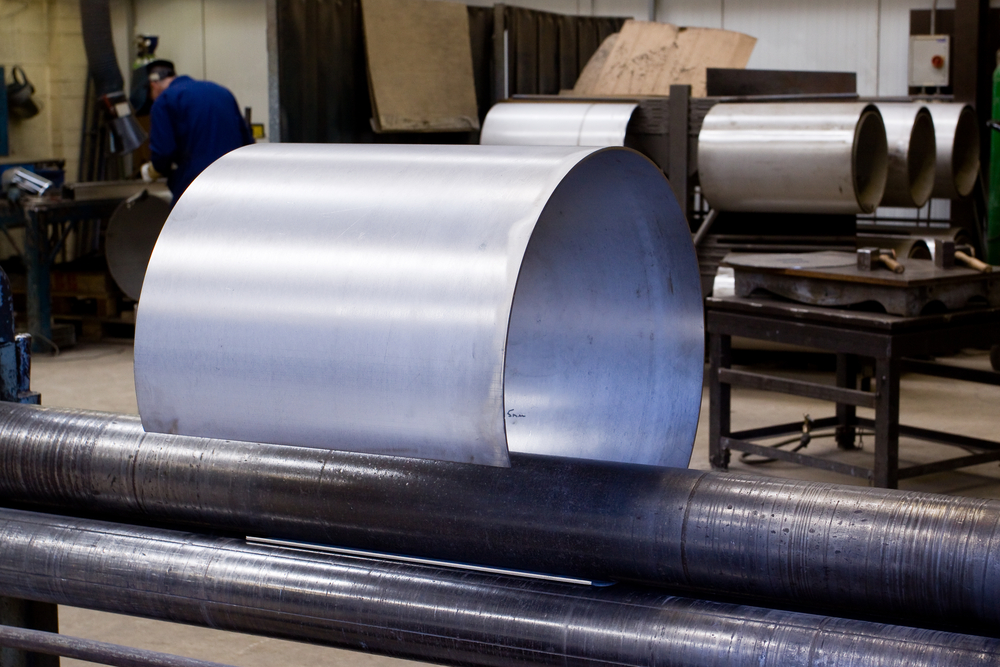
An often-underappreciated piece of sheet metal machinery, the plate roller is made specifically to roll sheet metal into conical shapes. This means it is still technically a bending machine – just a very specific type of one. Three and four-roll systems are pretty common types of plate rolls but there are other types as well.

Essentially, the sheet metal is passed through a set of rolls that work together to smoothly bend the sheet. Picking the right plate roller depends on the width, thickness, yield, tensile strength and diameter of the sheets you’ll predominantly be rolling.

4.    Bandsaw (Cutter)

Available in both horizontal and vertical varieties, the bandsaw is one of the easiest and quickest ways to cut through metal. As an added bonus, it is also able to cut through, wood, tile and plastic, as well as carry out irregular cuts – making it a versatile machine. Horizontal bandsaws hold the piece you’re looking to cut in place and then brings down the saw to cut it. 

Whereas, a horizontal bandsaw sits upright and allows you to slide the material you’re cutting through it. Horizontal bandsaws are a lot more suited to irregular cuts as you can guide the material in the shape, you’d like to cut it into. This is great for cutting out patterns.

5.    Press brake (Bending machine)

Whilst we mentioned above that the slitter folder is a fantastic all in one bending machine that automatically changes its tooling to match the required job – a press brake is still a fantastic machine and here’s why. Press brakes can handle any type of sheet metal – no matter what its thickness is – making it more desirable for those heavy-duty sheets. You can also purchase a wide range of tools for it allowing it to tackle several types of bends. As opposed to a slitter folder, the tooling is pressed downwards from above. These machines are available in hydraulic, electric and mechanical varieties.

Are you looking to purchase sheet metal machinery?

ACRA Machinery stock an extensive range of both new and used sheet metal machinery including press brakes, bandsaws and fibre laser cutters. Our knowledgeable and experienced technicians can help you find the right fit for your workshop and ensure you get the best quality sheet metal machinery.

We also offer comprehensive repair and maintenance services to ensure your machines are kept in tip-top condition. This includes regularly scheduled maintenance where we come to you as well as repair solutions for a variety of machines.

If you’re interested in purchasing sheet metal machinery, then please get in contact with us by filling out the form on our website or by calling 03 9794 6675.

Plasma Cutting The Safe Way

plasma cutter is a brilliant and useful tool to have in your arsenal of metal fabrication machinery. It’s tried and true and can take on a variety of different types of metal of varying gauges. But like with any metal fabrication tool, there are certain safety procedures and precautions that should be taken – especially when it comes to clothing. This is to ensure you produce the best quality products as well as keep your personnel safe in the process.

Protective clothing

Adequate protective clothing should always be worn by all operators. The burns from a plasma cutter can be quite severe – and to make things worse, some of the rays produced are invisible. This makes it even harder to pinpoint where to stay away from. On top of this, the clothing will shield you from shocks and sparks as the machine will also put out a lot of voltage as well as produce an electromagnetic field. PPE clothing is highly recommended in this scenario.

Goggles

Welding goggles and general face protection is highly recommended as the highly concentrated rays and flares produced by the plasma cutter can be quite dangerous and harmful – especially when it comes to your face. You’re also going to want to avoid directly looking at a plasma cutter’s arc as it can cause damage to your eyes and eventually lead to blindness. 

Because of this, we also recommend using goggles or protective face gear that are shaded to lessen the effects on your eyes. Certain shade ratings are appropriate for corresponding arc current (amperes) units.

Gloves & footwear

In an ideal world, the operators won’t be harmed when using such machinery – however, accidents do occur. Wearing heavy-duty, shock resistant PPE gloves is the first step to mitigating any injuries sustained from accidentally touching the wrong surface. The sheer power generated by a plasma cutter is quite dangerous. So, if you accidentally come into contact with the torch tip or any surface that is connected to a part of the machine that is outputting such high voltage you’re going to want to ensure you’re adequately protected.

It is also generally a good practice to wear gloves when handling heavy machinery as even simple accidents like hands getting caught in moving objects or cuts from sharp edges can occur. These can be mitigated if the appropriate measures are taken. The same can be said when it comes to footwear – strong industrial boots should be worn to lessen the chance of physical injury occurring and a dry mat should be stood on to insulate you from electric shocks.

Ear protection

The last thing you want to do is cause irreparable damage to your ears – which is why ear protection is so crucial when operating plasma cutters. The decibel levels can get fairly high with this particular machine and a mixture of sharp noises and heavy shocks can wreak all sorts of havoc with your audible systems so you’re definitely going to want to look into appropriate earplugs. If the proper methods are not followed, then the loss of hearing can occur.

Cleaning your machine

Whilst personal protective clothing is essential, there is something else that could mean the difference between a good and bad day when operating a plasma cutter – and that’s the cleaning and maintaining of it. Best case scenario, your machine won’t operate if it’s insufficiently maintained or cleaned – but the worst case could mean that accidents occur. It’s important to ensure your machine is always kept in tip-top condition and is regularly cleaned. Please refer to our plasma cutting maintenance blog for further instructions on how to go about this.

Are you looking for a plasma cutter?

When it comes to sheet metal machinery, nobody knows the equipment better than ACRA Machinery. Our technicians live and breathe sheet metal machinery and can help you find the perfect machine. With our extensive range of new and used machines such as plasma cuttersslitter folders and press brakes – you’ll find it tough not to find a solution to your problem.

Need a machine repaired or serviced? Our technicians can help you out with that too as we provide a full suite of on-site maintenance and repair solutions for all types of metal fabrication machines. We’ll even come to you to make things easier on your end.

So, if you’re looking to purchase a plasma cutter or would like to know more about our other products and services, please don’t hesitate to contact us through our website or give us a call on 03 9794 6675.

Preventing Unnecessary Industrial Machinery Repair And Maintenance

Industrial machinery repair can be a costly and time-consuming undertaking. The worst part is that it can happen at any time, and Murphy’s law will say that your machine will breakdown at the moment where it most inconveniences you and your business. Whilst we offer both regular maintenance and repair services – we want to make sure your machine is running optimally and you’re keeping it in tip-top condition on a day-to-day basis. So, for today’s blog, we’re going to be taking a look at some fundamental self-maintenance tips you can follow to keep your fabrication machine running like new.

Ensure it’s clean

One of the biggest causes of machine breakdowns is dust, dirt, grime and other general nasty substances building up over time in various parts of the machine. These can cause minor to major issues within machines depending on where the build-up is. For example, a laser cutters’ optics must be spotless at all times to ensure maximum efficiency.

Luckily, this is something that can easily be prevented with a simple cleaning routine. Give the machine a look-over at the end of each day and clean any visible dirt. Even if there’s nothing very visible you should still give it a once over as it’s a good habit to get into.

Familiarise yourself with the manual

To really look after a machine, you must understand everything about it – really know it inside and out. Not only will this help you to care for the individual machine properly, but it will also let you utilise its full potential when it comes to fabrication.

If you’re experiencing an issue with your machine, then we recommend consulting the operators manual first as there may be a hidden piece of wisdom that could help with your situation. At the end of the day, what may seem like a major issue could only be something minor that you’ll be able to fix yourself.

Practise proper operational methods

Make sure that only qualified and trained professionals operate the equipment and that they’re adequately familiar with the machine. Depending on the machine, the operator should also be supervised by a superior. This is to mitigate any human error and ensure the best possible safety practices.

This also includes any changes that must be made to a machine – for example, with plasma cutters you should test the gas quality regularly to ensure there are no contaminants found. This can be done by putting the machine in TEST mode and blowing air out of the torch onto a clean paper towel.

Identify any issues early

If you notice any faults or areas where the machine is lacking, then don’t wait to have it checked out. Stop using the machine and consult the manual. If nothing can be found in the manual, then you should contact us so we may assess and remedy the issue.

This is especially crucial for any physical defects or damage you may find on the machine. We have years of experience in industrial machinery repair and can work onsite to fix your machine.

Schedule regular maintenance

Sometimes minor in-house maintenance isn’t enough, and eventually, you’ll need professionals to take a look at the machines and perform routine assessments. So, on top of these tips, you should get in touch with us to organise regular maintenance services.

This can go a long way in ensuring your machine lasts and operates at maximum capacity whilst also extending its operational life. By setting up a maintenance schedule with us you can ensure your metal fabrication machine gets the best possible care and runs like new every time.

Interested in industrial machinery repair?

Sometimes the day-to-day care you give to your machine just isn’t enough to maintain it in the long run and there’ll come a time where professional maintenance is required. ACRA Machinery is well-versed with all types of machinery repair and maintenance practices. Our experienced and veteran experts can handle anything from industrial machinery repair to casual maintenance.

As fabrication machine experts – we also stock an extensive range of both new and used sheet metal machines such as press brakes and slitter folders from several reputable and world-renowned brands like Jorns and Durma.

If you’d like to know more about our industrial machinery repair services, or the products we sell, then please contact us through our website or give us a call on 03 9794 6675.

DURMA HD-F/HD-FS Product Spotlight

In our last blog, we looked at what a fibre laser cutter was and how they’re more efficient and superior compared to CO2 gas lasers. Well, today we’re going to be taking a look at two specific fibre lasers that we’re proud to be housing – Durma’s HD-F and HD-FS Fibre Laser cutters. Branded as The Winning Force, these two fibre laser cutting machines are highly advanced and completely reliable – let’s take a closer look at these two machines.

The basics

As we now know, a fibre laser utilises an optical fibre that has been doped with rare-earth elements to strengthen the laser beam – making it very powerful and efficient whilst still using a cheap diode to fuel it. So, we already know that these two machines are cost-effective and efficient as well as having low operating costs and energy consumption rates.

The Durma HD-F/HD-FS offers precise cuts on both thick and thin materials with perfect results on several types of materials as well. Their high-quality and durable craftsmanship is recognised globally along with their premium components – resulting in a sturdy, well-crafted machine that will tackle a range of jobs for years to come.

There are also low investment and operating costs involved when purchasing one of these two machines as fibre lasers require little maintenance to begin with. Coupled with Durma’s high-grade workmanship and you’ll rarely have to worry about repairs or upkeep. If you’re one for aesthetics – then you won’t be disappointed with either of these machines as they feature the unmistakable white, blue and red finish of a premium Durma machine.

The difference between the HD-F and HD-FS

The two machines are virtually the same in almost every way and they even use the same components. The major difference between the two is that the HD-FS is a smaller design as it was designed to be a lot easier to load and unload without the need for a shuttle table. If floor space is an issue – then we recommend looking into the HD-FS model.

The rack and pinion motion system

Included in both the HD-F and HD-FS laser cutter models is the rack and pinion system which controls the motion of the axes. Outstanding precision and acceleration are achieved due to the low clearance, hardened helical racks. This system can reach speeds of up to 100 m/min. Additionally, precision is never lost in this system due to the lack of intermediate load transmitting elements between the motor and the pinion.

The ProCutter head

Durma is able to complement their innovative and robust laser cutters spectacularly with Precitec’s ProCutter 2.0 laser cutting head. The ProCutter is the answer to all your laser cutting solutions – offering precise cuts for all types of thicknesses. This diverse suite of capabilities makes the ProCutter 2.0 the perfect head for any laser cutter.

It’s lightweight and petite design boasts increased speeds whilst still maintaining high-precision and efficient productivity. With multiple optical configurations that are optimised for several various applications and an auto-adjusting zoom lens for the focus diameter – this laser cutting head is undoubtedly versatile and solidly built, making it the perfect match for both the HD-F and HD-FS.

Notable features

  • The Z-Axis is able to achieve high acceleration speeds without causing vibration due to the light yet strong construction of the bridge, allowing highly accurate cuts and geometry to be attained.
  • A lateral scrap conveyor is an optional feature that’ll automatically remove scrap pieces from the working area without disturbing the cutting process.
  • The multi-chamber high-efficiency suction system allows for an equal amount of suction to be made across the whole machine during operation.
  • Multiple integrated shuttle tables are integrated onto the HD-F unit to minimise handling time and maximise productivity. This allows you to easily load and unload sheets or finished parts while the machine is still operational. The HD-FS model is optimised to still be easy to load and unload without the need of a shuttle table.

CNC capabilities

Both the HD-F and HD-FS come with the Sinumerik 840D CNC controller – which is a highly reliable and efficient 32-bit microprocessor system that features an integrated PC. With a Durma operator interface and complete cutting database – which includes all standard cutting parameters for a variety of common materials and thickness ranges – you’ll be all set with this control panel that also has full CAM/CAD software compatibility.

In need of a laser cutter?

ACRA Machinery are premium suppliers of Durma products – including the HD-F and HD-FS Fibre Laser cutting machines. We also offer both new and used sheet metal machinery and offer on-site repair and maintenance for a variety of different machines.

If you’d like to know about a specific type of laser cutter, then please get in touch with our team of professionals by calling us on 03 9794 6675. You may also contact us by filling out the form on our website.