In professions which require prolonged periods of time spend standing on hard surfaces, long term circulatory problems and physical fatigue issues are an ongoing problem. For those in the sheet metal manufacturing industry, providing employees with an effective buffer between their feet and the concrete floor is not only an occupational health and safety issue, it can also help boost productivity. This week, we take a look at some of the key benefits of anti-fatigue matting in the workplace.
Posture
Anti-fatigue mats help distribute bodyweight evenly on both feet and also provide support for the legs and spine, resulting in a healthy natural posture.
Body aches
Another benefit of providing support for the legs is that it alleviates some of the pressure put on the legs and back to stabilise the body in the standing position. Ultimately this results in less stiffness and pain in the neck and joints.
Blood circulation
Putting less pressure on the legs through subtle movement also means that the muscles and veins are relaxed, so blood circulation improves and the tight, swollen sensation often experienced at the end of a long day spend standing up is eliminated.
Energy levels
Your body has to put a surprising amount of energy into standing and performing passive work tasks like operating machinery. Anti fatigue matting reduces the amount of energy your body has to put in to passive work tasks, enabling you to work longer and without pain.
Safety
Anti fatigue mats are designed to prevent slipping, and are ideal in industrial workplace environments where spills are common.
Comfort
By eliminating the pain, tension, and discomfort associated with standing on a hard surface fro an extended period of time, anti fatigue matting makes it easier for employees to perform, and keeps them feeling physically comfortable and supported throughout the working day.
Productivity
Removing the source of pain and discomfort also enables your workers to perform tasks faster, and to a higher standard, ultimately improving your bottom line.
Acra stocks a range of quality anti fatigue matting in 1,2,3 and 4 metre lengths (900cm wide) with custom sizes available upon request. We currently have an introductory rate of $175 +GST/metre for these new products so if you want to improve the health of your workplace, give us a call today on 03 9794 6675.
Although each specific piece of sheet metal machinery has its own purpose, the invention of laser cutters has greatly transformed the sheet metal industry. In this blog we take a look at how laser cutters differ from their mechanical counterparts and the characteristics that make them so beneficial to the sheet metal manufacturing industry.
Laser cutters minimise mechanical force and stress
While traditional metal cutting technology like turret punches, shears and guillotines are effective, they do have the disadvantage of creating weak points in the metal they are used to cut, due to the force applied while using them. Laser cutters, however, are able to make clean cuts without the application of force, and the heat they generate is very localised on the source material. As a result, sheet metal cut with laser cutters retains more tensile strength than metal cut with traditional machinery, allowing it to take more weight.
Achieve incredible accuracy
Mechanical machinery does not always produce a clean cut, meaning cut sheet metal will often require extra work to remove any sharps and burrs at the edges. Laser cutters eliminate this process as their targeted cuts produce very clean edges. What’s more, the extreme precision of laser cutters allows for increased freedom of design; they can be used to easily and accurately cut complex shapes, fine contours and tapered cuts.
Do away with waste
The combination of reduced mechanical stress and improved accuracy means each piece of sheet metal can withstand significantly more cuts than sheet metal cut with traditional machinery. With fine precision, cuts can be made very close together, and because there are less weak spots, more of the metal can be used. This, of course, results in less wasted material.
And there you have it, three ways that laser cutters are changing the face of sheet metal manufacture. ACRA stock a range of new and used sheet metal machinery, including a large variety of laser cutters. For any enquiries, please call us on 03 9794 6675.
Sheet metal is an extremely versatile resource and is used in a wide variety of industries. Sheet metal manufacture benefits many different fields, so in this blog we take you through a few industries where sheet metal is most commonly used.
Building and construction
Sheet metal is used extensively throughout the building and construction industry, both as an exterior and interior material. Exterior uses include things like rain gutters, roofing and roof flashing, awnings, columns and balustrades, decorative facades, and metal domes. Sheet metal’s interior construction uses include air ducts and flues, furnaces, bathroom fittings, and even decorative wall coverings made to resemble masonry.
Transportation
Another industry that would not have evolved and expanded without sheet metal is the transportation industry. Sheet metal has many uses throughout the transportation industry; it is used to manufacture the bodies (and inner workings) of ships, cars, trains and even aeroplanes. Sheet metal’s flexibility, durability and comparatively light weight makes it the perfect material to be used in the manufacture of various transportation vehicles.
Armour, weaponry and equestrian
When sheet metal was first invented it was commonly used to make plate armour for men in cavalry. While plate armour is no longer used, sheet metal’s historical use in associated items like horse tack still lingers on today. Sheet metal is also used in the manufacture of weaponry, including guns and tanks.
Sheet metal has a huge range of uses and its invention completely changed the face of metalworking. In order to cut, shape and resize sheet metal to suit different applications, a range of specialised tools and sheet metal machinery are required. ACRA stock a huge range of new and used sheet metal machinery, including machines like press brakes, laser cutters, band saws, section rolls and more. To find sheet metal machinery suited to your specific requirements, call us now on 03 9794 6675.
Sheet metal manufacturing is not an industry that is well known or understood by the general public, and part of the reason for this is the scale of the industry as well as the complexity of the machines and processes used. This week, we thought we’d begin to demystify the industry with a glossary of basic key terms which pertain to modern sheet metal manufacturing processes.
Laser cutting
Using a highly concentrated light beam to pierce or cut metal.
Gauge
Referring to the thickness of the metal. Some of the standard guage sizes include Galvanised Sheet Gauge (GSG), Birmingham Wire Guage (BWG), and United States Standard Guage (USS).
CNC
An abbreviation of Computer Numeric Control which is a machine run by a computer which is programmed with commands.
Die cutting
This refers to the process of cutting metal pieces without melting or burning. Also known as shearing, die cutting produces no chips.
Die forming machines
Metal forming machines which impart a contour on a sheet of metal with a pair of mating dies.
Hydro-forming
A metal forming technique which uses liquid pressure to shape plastic or metal. As a metal forming technology, fluid pressure is used to move the ram for open and closed die forging and in plastic moulding the fluid itself is used to exert the forming pressure.
Press brake
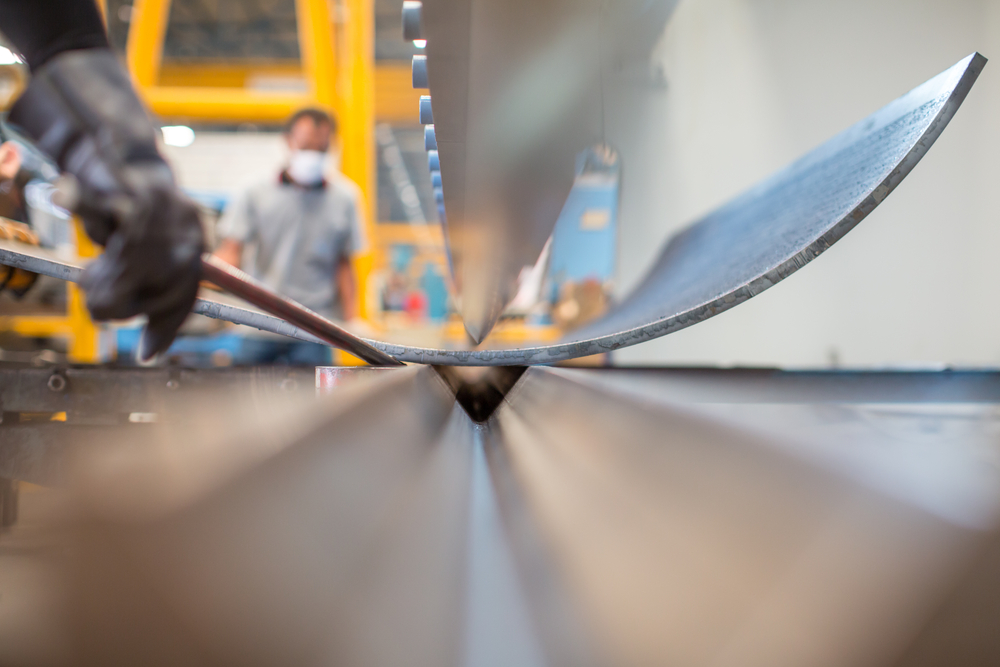
A tool used to bend both sheet and plate metal.
Milling
Where rotary cutters remove material from a piece of metal. The axle of the tool is used to advance the cut in an angled direction.
Stamping
Cutting and shaping alloys into specific shapes such as machinery parts, pre-determined shapes, and structural components.
Stretch forming
A forming process used to produce parts with a large radius of curvature. It’s achieved by applying tensile forces to stretch the sheet over a form block.
Roll forming
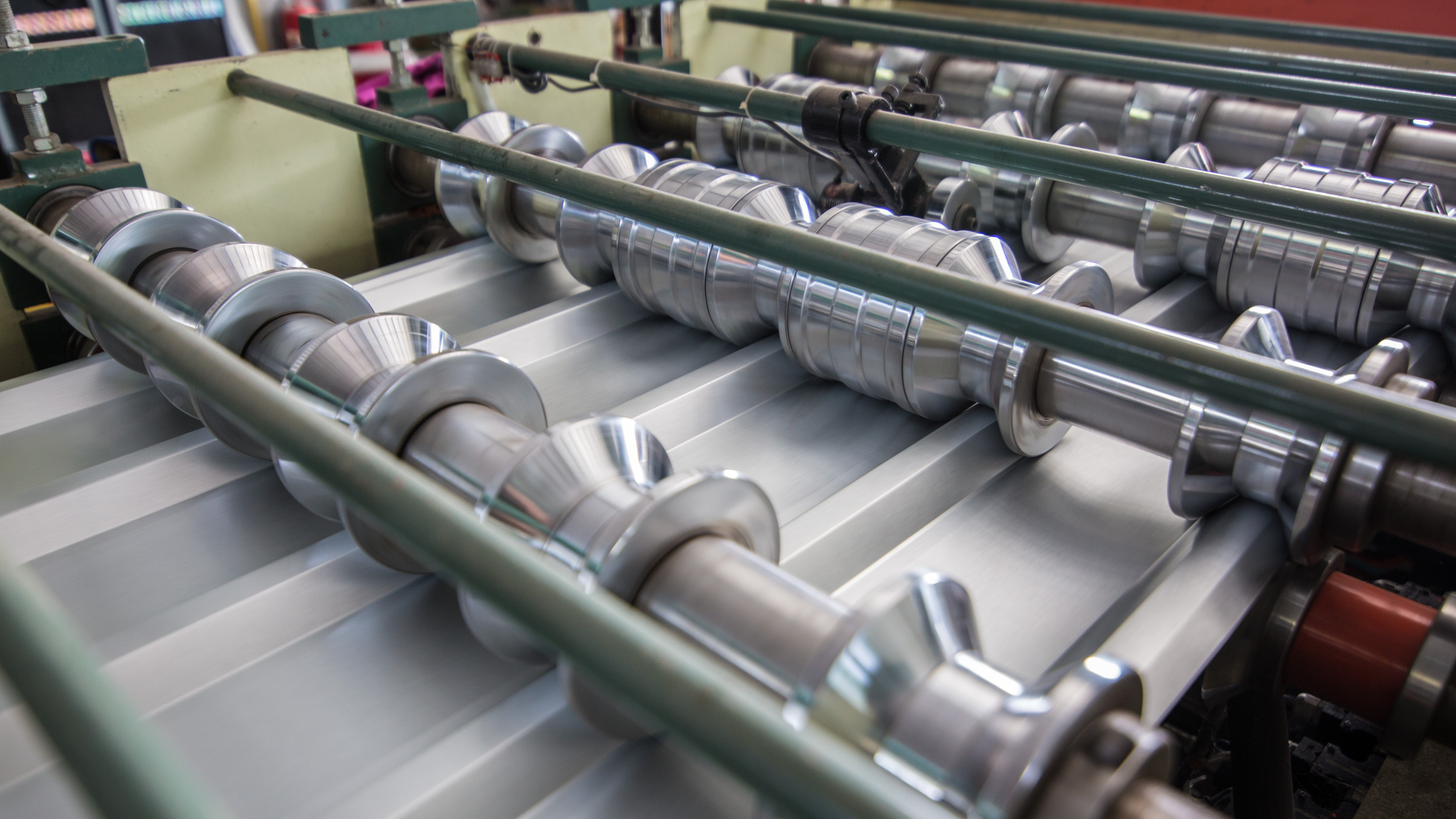
A bending process wherein metal passes through rolls to form sheeting.
Hydraulic breaks
A tool which creates bends at predetermined angles to simplify the fabrication process.
Plasma cutting
A cutting technology which uses a concentrated jet of ionised gas (plasma) to generate electricity and heat in order to melt and blow away the molten metal.
ACRA are trusted vendors of both new and used sheet metal manufacturing machinery. To learn more about our range of products, please don’t hesitate to get in touch with us by calling 03 9794 6675.
Shearing devices play an important role in the sheet metal manufacturing industry, so naturally, there are a plethora of machines designed to perform the many different shearing functions required to achieve a smooth and accurate finish. This week, we take a look at seven of the most common types of shearing devices used in the sheet metal manufacturing industry, including the metal guillotine.
#1: Alligator shear
So-called because of the hinged jaw used to cut metal, alligator shears are powered by a hydraulic cylinder and are mostly used for cutting long metal stock like l-beams, angle iron, pipe or rebar, or to prepare scrap metal for shredding by lopping off anything the shredder will not accept or non-metal fittings.
The cutting motion is actuated by a piston which extends to slowly close the upper ‘jaw’ down alongside the bed. The key strengths of an alligator shear are its cost-effectiveness, strength and durability, it’s drawbacks are its inaccuracy and rough finish.
#2: Metal guillotine
Guillotines consist of a shear table, work-holding device, a gauging device and upper and lower shears. It can be mechanically, hydraulically, or foot-powered and works by clamping the metal with a ram, then moving a metal blade down across a fixed blade to make a cut. The moving blade can either be straight or set on an angle, to decrease the amount of force required to cut a larger piece of metal.
The key strengths of working with a metal guillotine include its speed and cost-effectiveness, which is ideal for high volume production. However, the biggest drawback of a metal guillotine is its tendency to produce a rough edge. These machines are ideal for process parts where aesthetics are not important, or where the metal will go on to be further worked through welding. Always ensure you are employing correct safety measures when operating a guillotine.
#3: Bench shear
A bench mounted shear that offers more mechanical advantage through a compound mechanism, bench shears are ideal for cutting rough shapes from medium-sized pieces of sheet metal. A dynamic piece of machinery, the bench shear can be used for a number of different purposes including 90-degree angle cuts and T-sections as well as cutting both round and square bars.
The strength of a bench shear depends on its size, with larger machines capable of withstanding the highest stresses, but broadly speaking, the key strengths of this type of shearing mechanism are its efficiency and ability to produce a clean cut that’s free of burrs.
#4: Power shears
Ideal for blanking large pieces of sheet metal, power shears are either electrically or pneumatically powered and operated by hand. They work with an upper blade moving towards a lower fixed blade and exerting tension on the cutting material. They are generally used for cutting straight lines or large radius curves.
The key advantages of power shears are their flexibility in cutting curves, efficiency, accuracy, durability and quality finish.
#5: Throatless shear
Perfect for making straight, intricately curved or irregular cuts, the throatless shear differs from the other models on this list because its design allows for the cutting material to be freely moved around.
#6: Snips
Snips are hand tools used to cut sheet metal. There are two different types of snips: tinner snips and compound action snips. Tin snips have long handles and short blades, and are generally used to cut low-carbon tin or mild steel. Straight pattern tin snips are ideal for cutting straight lines or gentle curves, whilst duckbill pattern tin snips are ideal for cutting sharper curves. There are also tin snips known as circle pattern, which cut circles, hawksbill pattern which cut radii on the inside and outside of circles as well as cuts which require sharp turns like when cutting holes in pipes.
The other type of snip is the compound action snip, which is used to cut aluminium, mild steel or stainless steel. This type of snip has a linkage, which increases mechanical advantages. Compound action snips come in three different types:
Straight-cutting (which cut straight and in a wide curve);
Left-cutting (which cut straight and in a tight curve to the left); and
Right-cutting (which cut straight and in a tight curve to the right).
Other variations of the compound action design include:
Upright snips, which are ideal for use in tight spaces;
Long cuts snips, which are ideal for making longer straight cuts; and
Hard snips with head treated blades that can be used to cut through tougher metals.
The key strength of snips is their precision and suitability for a wide range of delicate cutting work. However, because they are hand-operated, working with snips is a labour heavy and time-consuming process.
#7: Nibblers
Although some nibblers work like tin snips, most work off a punch and die formation. Nibblers work via a blade which moves in a line around a fixed die in a series of up and down punching strokes, ‘nibbling’ away at the material to create a cut.
The advantages of nibblers include their robustness and durability, its ability to produce distortion-free cuts, speed, and low force feed.
Buy a metal guillotine today
ACRA specialises in state-of-the-art sheet metal machinery and has a number of new and used metal guillotine products available.
To learn more about our capabilities, please don’t hesitate to get in touch with us by calling 03 9794 6675.
A long length slitter folder essentially bends sheet metal. This is its basic function. The size of sheet metal that can be bent as well as how fast it can bend it is entirely up to the machine. That’s why this week, we thought we’d take a look at the key benefits of one of the most exciting new product ranges to arrive at ACRA; the Jorns long length slitter folders. These slitter folders are available in both the single variety and the double. We’ll explain the difference between the two in this blog as well so don’t worry.
1. Jorns are veterans of the sheet metal processing and mechanical engineering industries.
Established in 1973, Jorns has a proven track record of success and today is an industry leader in the development, sale and manufacturing of bending machines like the long length slitter folder. The Swiss-based company only pumps out 120 long length slitter folders per year – 40 of which are double slitter folders. These machines are manufactured by a workforce of 70 specialists who stick closely to the company’s motto of “Power of flexibility”.
2. They are peerless in terms of continuous output
All Jorns machinery is manufactured using state of the art materials and technology including laser, welding robots, and CNC machining centres. This ensures high quality operation and a long lasting life-span. There are 5500 Jorns slitter folders in current operation around the world being utilised in various professions.
3. State of the art safety features
Sheet metal machinery can be dangerous – and accidents do happen. That’s why Jorns’ safety features are seamlessly integrated into their machines and are designed to be easy to use. Every machine is fitted with a multi-beam laser system which scans for potential hazards when closing, well before the hazard zone is actually reached.
In addition to this, all machines feature a continuous emergency-off rail – as well as an emergency-off button on the control panel. The shear has its own latch that can be adjustable. The latch is positioned to be ahead of the shear so that if it hits a hand first then the shear itself will come to a halt and thus avoiding any accidents from occurring.
4. Modular Design
The aspect that makes these machines so unique and unparalleled within the industry is their customisability. You’re able to configure things like the back stop system, shear type, control system and the hydraulic system of your Jorns long length slitter folder. You can also compensate for any deformations that may occur at the end of the profile you’re bending with a dynamic positioning module – which is an exclusive Jorns innovation. By inserting the various types of modules, you can truly make your bending machine your own.
5. Able to work with a wide range of thicknesses
Unlike many machines in the sheet metal manufacturing industry, the Jorns slitter folders are able to work with a wide range of thicknesses – from 1.25mm to 3mm in terms of steel sheets. The bending length can also be customised from 4000mm to 12200mm.
The double slitter folder also operates with the same specifications as the single – however it can multitask. This means that several profiles can be bent at the same time – improving production time. With the implementation of servo-technology – minimal physical contact is required as the machine will automatically load and unload the sheet metal.
6. State of the art design
All Jorns bending machines are mounted on a frame, driven by a state-of-the-art hydraulic unit, and include all the levelling and fastening devices necessary to preserve quality. Key design features include proportionally controlled speeds, overload protection, bending cylinders with damping and pipe-break safety devices and top beam with load relief.
7. User friendly control system
Jorns bending machines are fitted out with user friendly controls on a mobile console and can be run with anything from a simple and straightforward 2-axis OP3100 control unit right through to a state of the art CP200 graphic control system – which offers a touchscreen and SSD memory.
You can also choose from six different software options – two of which are designed in-house at Jorns – that can let you work the way you want to work. Depending on the software you choose, you can even use it on your mobile or tablet for a completely integrated experience with your bending machine.
Interested in a Jorns slitter folder?
Whether it’s the single or the double long length slitter folder – ACRA Machinery has you covered. Not only do we offer both of these intuitive and incredible Jorns products, but we also offer installation and repair services for them as well – administered by our highly skilled and knowledgeable staff. We also offer a wide range of other sheet metal machinery products such as press brakes and bandsaws with both new and usedoptions available for purchase.
If you would like to know more about our long length Jorns slitter folders – or any of our other products and services – then please give us a call on 03 9794 6675. You can also fill out the enquiry form on our website hereto get in touch with us.
There’s a huge range of sheet metal machinery on the market, and each machine has its own capabilities, advantages, and disadvantages. This week we take a look at three different kinds of cutting machines used in sheet metal and their key features.
Hand Shears
Hand shears are a manual tool for cutting sheet metal and are essential when working in sheet metal fabrication. Hand shears work similarly to scissors, with two blades producing a shearing force to create accurate, clean cuts. Hand shears can come with regular and specialised jaws and are simple to operate, allowing the operator to cut back or trim sheets for a variety of purposes including domestic roofing, bull nosing, water tanks, pergolas and sheds.
Plasma Cutter
Plasma cutters are extremely versatile and can be used to cut paper thin grades of sheet metal right though to ¾” steel. Plasma cutters work by running an accelerated jet of hot plasma across electrically conductive metals (including steel, aluminium, brass and copper), melting through the work piece to create extremely accurate cuts. Plasma cutters are best used for making long, straight cuts and are used in industries like automotive fabrication and repair, industrial construction and scrapping operations.
Guillotine
Guillotines work similarly to hand shears, however are much larger and much more powerful. To cut sheet metal with a guillotine, the workpiece is first clamped with a ram, then a moving blade (upper blade) comes down across a fixed blade (lower blade) to shear the material. Guillotines can be operated manually (foot or hand operated), mechanically, or hydraulically. Hydraulic guillotines are able to use much more force than mechanical guillotines, allowing them to cut thicker grades of metal. Guillotines are an efficient way to create long straight cuts in a variety of different sheet metals.
There is a huge range of sheet metal machinery available for cutting sheeting metal, and each kind of tool has its own unique abilities and advantages. ACRA stock both new and used sheet metal machinery and will gladly source a machine to suit your specific cutting needs.
Customer loyalty is a concept that often gets bandied about in the retail industry but it can also be successfully applied to industrial manufacturing sector. This week, we take a look at how you can build and reinforce a loyal base of customers as a sheet metal manufacturer.
Keep them informed
Set up a contact database of customer information so that you can reach out to your established customers on a regular basis. In a manufacturing context, this communication is generally most effective when you’re providing value adding information such as industry news or updates on your services and capabilities in a monthly newsletter.
Offer exceptional service
Customer service isn’t something that exists exclusively in the retail sector. Any type of consumer will respond strongly to a positive service experience so it’s important to go the extra mile wherever possible by being communicative, prompt, flexibly, honest and open to any criticisms.
Encourage employee loyalty
A loyal customer base can only exist in a company that runs smoothly and produces quality. For this reason, it’s crucial to build trust and loyalty amongst your most valuable business asset, your employees. If you build a business based on integrity and competency, your employees will not only respect and trust you, they will be proud to represent your brand. In an insular industry like sheet metal machinery where reputation is everything, this kind of positivity is very well received and will shape the way potential clients see your business.
Offer incentives
Incentives give clients a reason to return to your business and they can be offered in the form of discounts, free products or services like shipping, and rebates.
Let your products do the talking
At the end of the day, a client is not going to return to you if they are dissatisfied with your work so it’s important to ensure you produce quality, deliver on time, and remain commutative with the client throughout the purchasing process.
Acra offer and extensive range of new and used sheet metal machinery for sale in Melbourne. To learn more about our capabilities, please don’t hesitate to get in touch with us by calling 03 9794 6675.
Sheet metal revolutionised traditional metalworking and is used in a huge array of industries. In this blog, we give you a basic rundown of how sheet metal is made, the various types of sheet metal, and a few of its common uses.
How Is Sheet Metal Formed?
Sheet metal is constructed in an industrial process where the metal is first melted, then poured into a mould, pickled (chemically cleaned), rolling, and annealing (the metal is heated, but not melted, and pickled again). Sheet metal is a fundamental element of metalwork and can be bent and cut into a variety of shapes to suit multiple applications. Sheet metal machinery used in the manufacturing process includes press brakes, plasma cutters, laser cutters, bandsaws, turret punches and much more.
Types of Sheet Metal
Many different types of metal can be turned into sheet metal, including aluminium, steel, copper, brass, tin, nickel, titanium, and even precious metals like silver, gold and platinum. Sheet metal comes in various thicknesses (a measurement known as its gauge). The higher the gauge number, the thinner the metal, with the thinnest forms being foil and leaf, followed by plate. Ferrous metals (iron-based) are usually much thicker than non-ferrous metals.
What Is Sheet Metal Used For?
Sheet metal is used in a wide range of industries, including manufacturing and construction. Some common things made from sheet metal are:
Architecture
Aeroplane wings
Car bodies
Hospital tables
Restaurant counter tops
Computers
Filing cabinets
Street signs
License plates
Mailboxes
Kiosks
Sheet metal with high magnetic permeability (usually iron-based) is used in transformers and electric machines. Sheet metal has historic uses too, such as in plate armour worn by cavalry.
Sheet metal is used in many different industries and is an extremely important component in manufacturing. ACRA stock a wide range of new and used sheet metal machinery, and can help with repair and maintenance services. For any enquiries contact us on 03 9794 6675.