Plasma Cutter Fact File

This week we give you a run down on one of the most popular types of cutting technologies used in the sheet metal manufacturing industry – the humble plasma cutter.

plasma cutter

What is it?

Plasma technology uses pressurised gas (usually nitrogen, argon or oxygen) which is sent down a small nozzle containing a negatively charged electrode. An electrical circuit is created when the tip of the nozzle comes into contact with a metal workpiece, creating a spark which heats the gas to the point that it becomes a stream of plasma.

How does it work?

When the super-heated plasma comes into contact with metal, it reduces the metal to molten slag which then falls away, creating a cut. The plasma stream is controlled by shielding gas, released by other channels in the nozzle. These can be altered to vary the thickness of the cut as well as protect against oxidisation.

Which industries are plasma cutters best suited to?

Plasma cutting technology has a wide range applications from industrial scale construction such as transport fabrication (vehicles, ships and planes etc.)  to small business (i.e. locksmiths).

What are the advantages?

Perhaps the biggest advantages of plasma cutting technology is its affordability when compared with more advanced cutting technologies. As it has been used in the sheet metal manufacturing industry since the 1980s, plasma technology is much more affordable when compared to newer innovations such as laser cutting but is able to remain competitive from an operational standpoint as it has been integrated with modern technologies such as CNC. Other advantages of plasma technology include it’s fast production speed, adaptability, versatility, low cost operation and good automation.

What are the disadvantages?

There are only two key disadvantages of plasma cutting technology. The first is a much wider kerf than laser and water jet technologies. The second is restrictions on dry cutting of up to 160 mm for dry cutting and 120 mm for cutting under water.


Acra sell high quality plasma cutter machinery in both new and used condition. To learn more about our range, or to chat with one of our knowledgeable consultants about the best technology for your needs, please don’t hesitate to get in touch with us by calling 03 9794 6675.


How to Run a Successful Manufacturing Business

The level of manufacturing across Australian industries has rapidly declined in recent years, with many manufacturing plants closing down and outsourcing their requirements to overseas factories. In order to maintain a successful manufacturing business in Australia, business owners and managers should focus on a few key factors, including innovation, productivity, investment, and funding, designed to keep them competitive in a gloabalised market.

manufacturing

Innovation

In order for local manufacturing businesses to remain viable, they need to put a strong focus on innovation. Innovation is often applied to issues like development and new technologies, however it also comes in handy for problem solving and business transformation. Examples of innovation specific to the manufacturing industry include refining supply and distribution channels, or exploring more efficient and cost effective ones­, improving processes, working to provide a better customer experience, finding ways to incorporate more environmentally friendly practices and technology, and establishing exciting new business offerings and connections.

Productivity

Boosting productivity in the manufacturing industry isn’t just about cost cutting – it’s also about increasing revenue. The best way to boost productivity is to develop a deep understanding of your industry and your customer base, and to discover ways to expand your services to meet market expectations. Making your internal processes more efficient and embracing new production technologies is a great way to further boost productivity.

Strategic investment

All successful businesses require investment in order to grow and survive industry pressures. One of the best investments a manufacturing business can make is in the workforce, hiring people with the skills and knowledge needed to stay ahead of worldwide trends. In manufacturing, your workforce is your biggest asset, so it pays to keep them happy and work to improve and expand their skills.

Funding

Of course, even when following all of the above, it’s unrealistic to expect manufacturing businesses to continuously turn over huge profits, so backup funding is needed to support the business when short-term dips in cash flow occur.

Focusing on these key areas will help your manufacturing business not only survive, but thrive in a globalised market, where quality at skill is more valuable than ever before. If you run a sheet metal fabrication business, look no further than ACRA for the highest quality sheet metal machinery.

How to Boost Worker Productivity in a Manufacturing Setting

On this blog, we often talk about the ways investing in advanced sheet metal manufacturing technology can help improve productivity. However, machinery is only half of the equation in the manufacturing industry and the human element is often overlooked as working on employee productivity tends to be a lot more complex than simply upgrading your machinery. Despite this, if you can get it right, improved worker productivity can have a significant impact on your bottom line and also help improve both  job satisfaction and morale. This week, we look at some of the ways sheet metal manufacturers can improve worker productivity.

learn how to boost worker productivity

Examine existing workflow

The first step in improving productivity is to identify inefficiencies in the workflow. To do this, you need to evaluate the processes, technology and of course the people required to produce your product. When focusing on employee productivity, look closely at things like procedures, communication tools and channels and resources to see if there is room for improvement. From there, value mapping can be an effective way to identify and monitor process improvement to see the impact on the workflow.

Anti-fatigue matting

Anti-fatigue matting can play an important role in boosting productivity as it enables workers to perform for long stretches of time without any pain. Anti-fatigue matting improves posture and blood circulation, reduces body aches, helps preserve energy levels and helps workers feel physically comfortable and supported throughout the day.

Invest in employee education

In an industry that is constantly evolving both in terms of technology and procedural processes, there are plenty of opportunities for employees to advance their professional skillset which ultimately adds value to your business and ensures you remain up to date with the latest specialist technologies.

Foster a team environment

Although it’s made up of separate stations, a manufacturing floor is most productive when everyone is united and working towards the same goal and lag, waste and conflict is kept to a minimum. Creating a co-operative environment requires a dual approach of running regular team building exercises and working with employees individually to ensure they feel comfortable and see themselves as part of the team.


ACRA are proud to provide Melbourne sheet metal manufacturers with a comprehensive range of quality new and used sheet metal machinery and accessories including anti fatigue matting. To learn more about our capabilities, please don’t hesitate to get in touch with us by calling 03 9794 6675.

4 Great Durma Press Brakes

ACRA Machinery sell a variety of new, used, and custom press brakes from our Melbourne warehouse, with hydraulic, mechanical and electric models available. Our partnership with Durma (Durmazlar), the largest manufacturer of sheet metal machines in Europe, enables us to supply state of the art machinery to Melbourne’s sheet metal fabrication industry. Durma’s machinery is renowned for its accuracy, reliability, and affordable price range.  Take this stellar supplier reputation and combine it with ACRA’s 150 years of experience in the industry and impeccable customer service and you can rest assured you will find the right press brake for your metal fabrication project.

At ACRA we stock the following 4 different new Durma Press Brakes to suit the differing bending needs of our customers.
urma PBF Series Press Brake Acra Machinery

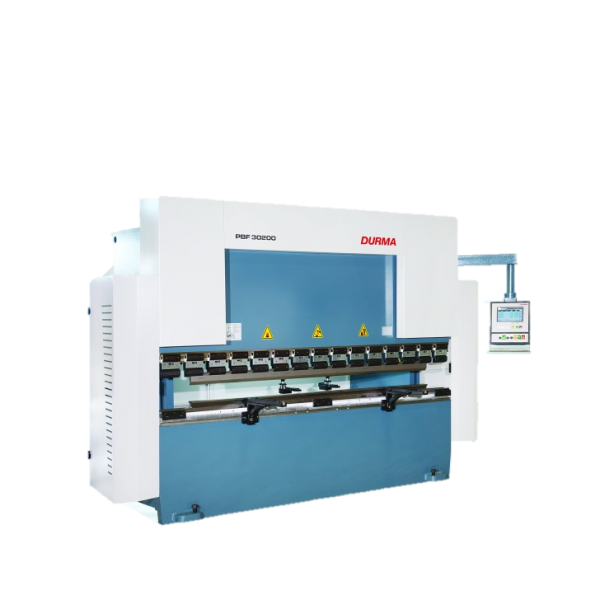
Durma PBF Series Press Brake

The Durma PBF Series Press Brake is an ideal machine for companies who do not require high stroke and/or multiple shift capacities. Low investment and maintenance costs, high productivity and the perfect performance/price ratio ensure you Durma’s PBF hydraulic press brakes can satisfy all your bending needs.

Each PBF Series Press Brake comes complete with:

  • a Manual Crowning System to simplify the bending process. There is no need for shimming as the crowning allows for perfectly straight bends across the length of the bed.
  • Rugged support arms with disappearing stops which are mounted to the front of the bottom table (comprising easily movable, fast & accurate feeding of parts).
  • Front Sheet Supports which enable finger-tip lateral adjustment as required by the bend length of the parts. Durma Press Brakes are designed in accordance with CE-Norms to prioritise your safety with appropriate height covers and laser light curtain.
  • Durma 10 Inch Touch Screen Control Unit with it’s easy to use, operator-friendly interface which makes it easy to keep everything under control.

PBF Series Press Brakes from Acra Machinery also come with a complete set of standard European top and bottom tooling from Euram. Backed by our 2-year warranty, the Acra Machinery Service Team operate nation-wide, looking after all your installation, commissioning & training needs for PBF Series Press Brakes.
ADS Durma Press brakes

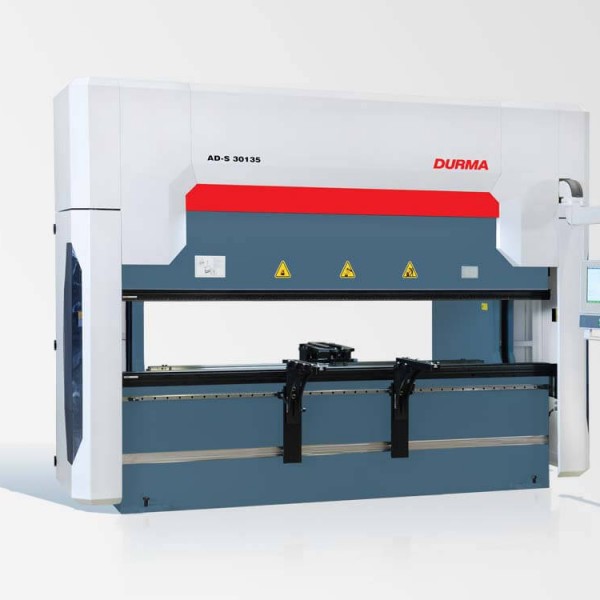
Durma AD-S Series Press Brake

The AD-S Press brake is available in up to eleven axis configurations and is a machine which has been designed to effectively decrease setup time.

The powerful yet simple control automatically calculates:

  • the bend sequence
  • the bend angle
  • the back gauge retraction
  • the bend allowance

It also features collision protection. The automatic calibration and + – 0,01 mm positioning accuracy make the AD-S an ideal companion for the production of all precision components, big and small.

DURMA AD-S Series Press Brakes are extremely accurate, reliable and reasonably priced machines. They offer the end user high flexibility, productivity and performance.
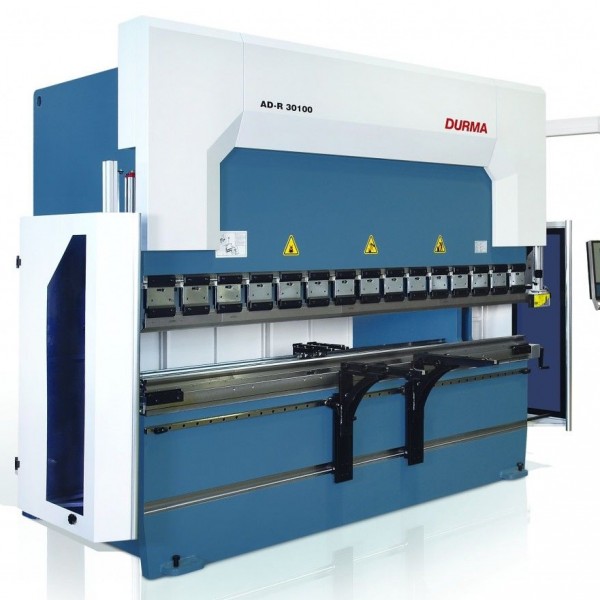
Durma AD-R Press Brakes

Durma AD-R Series Press Brake

The Durma AD-R Series Press Brake provides true innovation in press brake design.
We believe the AD-R Series represents the best performance/price ratio CNC press brake in the world, boasting the optimum combination of performance, value and simplicity. AD-R series press brakes are designed to faciliate cost-effective manufacturing and feature easy-to-use beginner level CNC programming with Durma’s renowned robust construction to permit perfect bending results with easy angle input and operation. The AD-R Series comes standard with:

  • 3 axis (Y1, Y2, and X with manually adjustable R)
  • large stroke and throat depths
  • Durma’s own 10″ 2D Colour touchscreen controller.
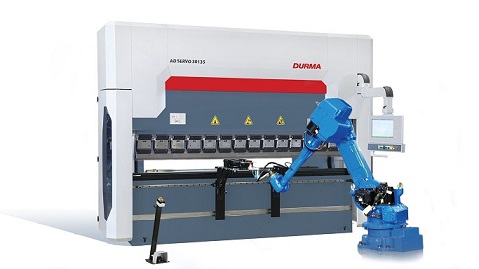
Durma AD Servo press brakes

Durmo AD Servo Press Brake

With the constant raising of electricity prices and ever increasing manufacturing costs now is the perfect time to look at investing in a Durma AD Servo Press brake.

Durma AD Servo press brakes offer:

  • up to 62% less power consumption compared to a conventional CNC Hydraulic Press Brake
  • greater speed and accuracy (up to 25% faster than a conventional CNC Press brake)
  • reduced noise levels
  • reduced maintenance costs

With ever increasing power and manufacturing costs, there has never been a better time to invest in a Durmo AD Servo Press Brake.
The use of Servo driven machines is on the rise around the globe and across all sectors of industry thanks to the competitive advantage this innovative machinery offers. Some manufacturers have even stopped producing hydraulic machines. Thanks to this increased demand and the recent trend of suppliers learning to build electric presses more cost-effectively, AD Servo Press Brakes are now significantly more affordable than

What makes Durma Press Brakes better?

  • Faster, more productive and more precise bendings
  • Rigid body structure
  • High sensitivity and repeatability
  • Low service costs
  • Hi-tech equipment
  • A brand you can truly rely on


Call Acra Machinery today on 03 9794 6675 to discuss your Durma Press brake options and discover how we can help you advance your production standards.

Tips for Getting the Most Out of Your Ironworker

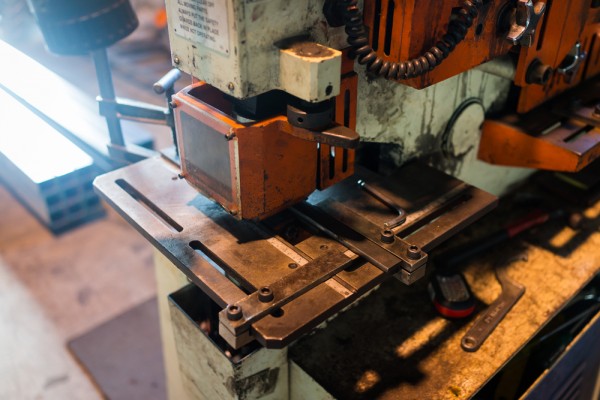
Endlessly variable and hardworking, ironworker machinery simplifies many difficult metal fabrication tasks. This week, we look at how you can improve the productivity of this already invaluable piece of machinery.

getting the most from your ironworker

Ironworkers have a punch, but don’t throw away your drill

Ironworkers tend to be limited in the hole sizes they can punch relative to the thickness of the material and cannot be used to punch a hole smaller in diameter than the material thickness.

More is better when it comes to throat depth

Throat depth should be deep enough for most of your work and be able to punch your largest part. Remember, you can’t add it later and if there is a special job, a drill can do the work instead.

Think carefully about the ironworker table

If you plan to use your ironworker for pipe notching or bending, it’s important to choose a table where the die holder is attached in a user-friendly way. Die holders can be attached with T slots, drilled holes, or tapped so it’s important to closely inspect before investing.

Die holder positioning is also important

If you need to punch close to the web, get a die holder where the die is near the edge of the holder rather than in the centre, as this can inhibit punching ability.

Different types of angle iron shear have different pros and cons

The slug-type angle iron shear is the best choice for those seeking a good cut quality, but it does cause some material loss and shimming. It also requires blade changes. If you need to cut a large piece of iron and want to avoid wasting materials however, the cropoff shear is the best choice, although it produces a lower cut quality.

The flat-bar shear is great for fabricating base plates, but quality varies

Different ironworkers offer different quality levels at this station and the rake angle in particular, can have a significant impact on the resulting cut quality. Broadly speaking, the higher the rake angle, the more distortion the drop piece has causing the material to roll or bow.


Acra stock a dynamic range of new and used sheet metal manufacturing machinery including ironworkers. To learn more about our capabilities, please don’t hesitate to get in touch with us by calling 03 9794 6675.


Metal Commonly Used in Construction

The sheet metal fabrication industry produces a large amount of metal that goes on to be used in the construction industry, so in this blog, we thought we’d look at some of the most common metals used in architecture along with their unique structural properties.

metal

Aluminium

Aluminium is a fantastic construction material as it is resistant to corrosion, ductile, and lightweight yet strong. It is also highly conductive. Architects favour aluminium as it is easily moulded, making it suitable for a wide variety of purposes including ceilings, walls, window frames, roofing, HVAC ducts and even bridges and other industrial construction.

Copper

Copper has been used for a variety of purposes for thousands of years and is valued for its conductivity, corrosion resistance, strength and ductility. Within the construction industry copper is often used as piping and tubing, along with cladding, electrical wiring and even roofing.

Iron

Two typed of iron are commonly used in construction: cast iron and wrought iron. Cast iron is melted, poured, and moulded, and is often used in large architectural projects. Wrought iron is rolled in the final production stages and is often riveted to make structural components like beams, trusses and girders.

Steel

Steel is commonly used in the construction industry as it is incredibly strong, durable, ductile and malleable. It is a fantastic conductor and can be recycled over and over again without degradation. Steel is used to make building frames, along with roofing, handrails, balustrading, cladding and more. Steel comes in several variations, including stainless steel and carbon steel.

Titanium 

Titanium is another lightweight metal commonly used in the construction industry. It is often used to construct heating and cool systems as it is highly corrosion resistance, however it is also found in pipes, roofing and even frames.

Sheet metal manufacturers play an important role in construction, as they provide the construction industry with much of their materials. If you’re a sheet metal fabricator in need

10 Interesting Facts About Laser Cutting Technology

In the sheet metal manufacturing industry, laser cutting remains the gold standard in terms of speed and precision but did you know this futuristic technology was first theorised about over 100 years ago? This week we uncover 10 surprising facts about the history of laser cutting technology.

laser cutting technology


  1. The relationship between energy and the frequency of radiation was first deduced by physicist Max Planck in 1900 who said energy could only be emitted and absorbed in chunks.


  1. This theory was extended by none other than Albert Einstein in 1905 with his paper on the photoelectric effect. In 1917 Einstein presented his theory on stimulated emission, the process which makes lasers possible.


  1. However, it would be 40 years before scientists would be able to prove Einstein’s theory in the lab. This was done in 1954 by Charles Hard Townes with the help of Herbert J, Zeiger and James P. Gordon.


  1. Originally the strength of a laser was measured in ‘gillettes’ which refers to the number of razor blades a laser beam can cut through. Today, the strongest laser is as powerful as a hydrogen bomb.


  1. Laser is an acronym which stands for Light Amplification By Stimulated Emission of Radiation. The term was coined by Gordon Gould in 1959.


  1. Ruby laser technology was first used in a cutting context to drill holes in diamond dies in 1965.


  1. In 1963 Kumar Patel developed the first Carbon Dioxide laser, which was more powerful and less expensive than the ruby laser previously used. A CO2 laser was the first to be used as for cutting metal in 1967 when it was used alongside oxygen jet cutting to cut through a 1mm thick sheet of steel.


  1. The Being Company was the first to use laser cutting technology in a manufacturing context in 1970, it invented multi-beam laser cutting technology and used it to cut through ‘hard’ materials such as titanium.


  1. 3D laser cutting was pioneered in 1979 and employed a 5 axes rotation system.


  1. Laser cutting is renowned for its accuracy and indeed laser measuring is accurate to just over a nanometre (a billionth of a metre).


Acra stock a top of the range laser cutter from leading sheet metal machinery manufacturer Durma. To learn more about our capabilities, please don’t hesitate to get in touch with us by calling 03 9794 6675.


How to Break in Your Bandsaw Blade Properly

Breaking in a bandsaw blade properly can prolong blade life, lead to faster cuts for longer and ensure more consistent performance. The teeth on a new band saw blade are extremely sharp and if they are not broken in correctly, the edges will chip and wear out faster, meaning rougher cuts in the long run. Today, we reveal the correct procedure for breaking in bandsaw blades without needing to buy anything new.

One useful analogy used in the industry is to think of the bandsaw blade as a new pencil with a sharp tip. You cannot apply too much pressure on a new pencil tip without it breaking and the tip becomes blunt with extended use. Bandsaw blades are very similar in this way. Breaking in a saw blade properly wears off this razor sharp edge and prolongs the blades cutting ability. Each manufacturer will have their own recommended method for breaking in their band saw blades. However, they all share the same key principles which we have outlined in the break-in procedure below.

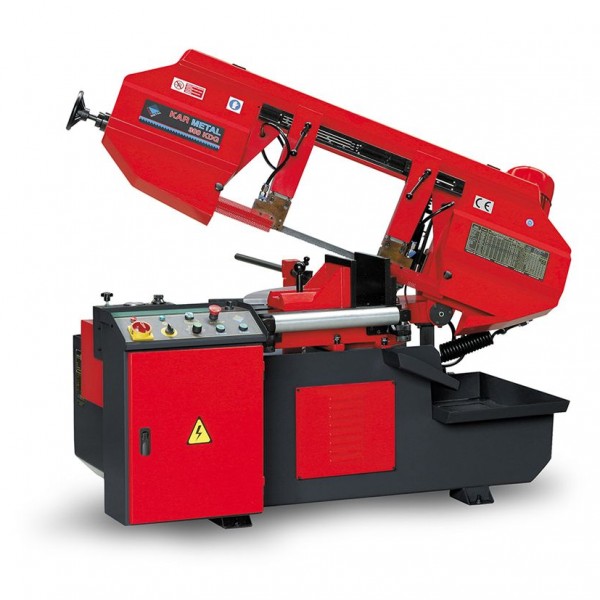
Karmetal KMT 300 KDG Semi-Automatic Mitre Bandsaw

KMT 300 KDG Semi Automatic Mitre Bandsaw

4 Easy Steps to Breaking In Your Bandsaw Blade

1. Set and use the recommended band saw speed (as per manufacturer’s recommendations)
2. Reduce the feed pressure/force control to approximately 50% of the normal cutting rate. Soft materials like aluminium require a larger reduction in cutting rate (around 50%) than hard-to-cut materials such as stainless steels and hardened steels (which require the feed pressure to be reduced to around 75% of the normal cutting rate).
3. Run at these settings for the first few cuts or around 50 – 100 square inches of easy-to-cut materials (323 – 645 sq. cm) and around 25-75 square inches of hard-to-cut materials (161-484 sq.cm). Begin the first cut at the reduced rate (make sure that the teeth are forming a good chip). Once the blade fully enters the workpiece you can gradually increase to the normal cutting rate or desired cut is achieved. With hard-to-cut materials make gradual increases in feed rate/force over several cuts until normal cutting rate is achieved.
4. Avoid unnecessary vibration (slight adjustments can be made to band speed during this process in the case of excessive noise or vibration).

Following this procedure as well as appropriate daily maintenance practices will allow your bandsaw blade to stay sharper longer, increase the consistency of your cuts and ultimately increase blade life.

Consult your supplier regarding the best break-in procedure for your machine

Once the blade is broken in, you should use the recommended band speed as per manufacturer’s indications. It is best to verify the correct break-in procedure for your particular band saw and relevant daily maintenance required with your supplier. Contact our friendly support team o 03 9794 6675 to discuss Karmetal and Durma band saw break-in and other maintenance procedures. We stock a range of automatic and semi-automatic models and can provide you with the right advice to help you keep your band saw blade in good working order longer and ensure consistent performance.

A Guide to Shear Maintenance

Most sheet metal manufacturing plants are fitted with shears – hand shears, foot-operated punch and shears, or both. Shears are incredibly useful in the sheet metal fabrication industry, so it’s important to keep them well maintained to ensure optimum performance. Read of for some essential shear maintenance tips.

shutterstock_502702249

Know the machine’s limits

It’s important to understand your machine’s function and limits, and to keep loads within the parameters outlined by the original equipment manufacturer. Your shears are designed to cut workpieces of a specified thickness and width, and exceeding load limits will likely damage your machinery. It’s important to set the shear blade properly, allowing for the appropriate clearances. When clearances are too tight, they result in poor cuts due to the metal workpiece being jammed between the blade and the machine. Clearances that are too loose put strain on the machines components, resulting in premature wear and machine failure.

Regular inspections are a must

Regular inspections must be carried out to ensure your shears are in working order. The inspection should include making sure the shears are properly executing their operational functions, checking bearings for lost motion and wear and ensuring that all emergency and safety functions are working.

Repairs should be made ASAP

If your shears are at all damaged or worn, repairs or adjustments should be made immediately. Putting off repairs can be extremely costly, as you will not only have to cover the costs of the repairs, but also the resulting damage. Immediate repairs are also vital to ensure the safety of your workers and prevent catastrophic accidents. Special attention should be paid to safety features such as the clutch and brakes and damaged shears should not be used until repairs are complete.

Cleaning is essential

Shears must be cleaned regularly to ensure full function. This includes thoroughly cleaning the lubrication system (along with continuously refilling and properly filtering it) and maintaining the air system to ensure the air is clean.

It’s important to pay close attention to your shears, and all sheet metal machinery, to ensure they are functioning correctly and efficiently. ACRA stock a range of quality sheet metal machinery including turret punch and plasma cutter. If require further maintenance advice, or need help choosing the right shears for your metal fabrication needs, call us today on 03 9794 6675.