
Common Bandsaw Mistakes

The bandsaw is a highly versatile power tool that can be used for both industrial-grade projects as well as personal hobbies. The primary use of a bandsaw is for cutting irregular shapes in surfaces such as wood and metal – provided the appropriate blade is being used.

But have no illusions, there are many things that can go horribly wrong if you don’t know how to properly use this power tool. Here are some common mistakes that people make whilst using a bandsaw as well as some tips on how to prevent them.

Watch your speed

It’s not easy to resist the urge to crank it up to 11, but if you don’t then you could run into some serious issues. You could dull or destroy your blade, snap welds or even creak teeth. It’s important to know the parameters that are required when cutting a certain piece of material.

Whilst you should always consult the charts and manual that come with your bandsaw, a good, general rule of thumb to follow is if it’s a thicker material than use a slower speed and a faster speed for a softer material.

Check your fluids

Bandsaws require specific fluids to be applied to the blade. These are known as cutting fluids. They’re applied to cool the blade, lubricate the teeth and wash away any chips. Some of these fluids must be mixed with water before application to the bandsaw blades and so it’s crucial that you constantly check on the solutions to see if there are any leaks. The water within the mixture will also evaporate as the machine is used so be sure to replace it when needed.

Break in your blade

This is an important step as you can’t use a new blade to its full potential if it hasn’t been broken in. To do this, set the speed of your blade to the manufacturers recommended speed and reduce the feed pressure to around 50% of the normal rate.

Cut 50 – 100 square inches of softer, easier to cut material and around 25 – 75 square inches of harder to cut material. If you don’t break in your blade correctly then you will run into a variety of problems such as dulling the blade quicker than usual and stripping its teeth.

Don’t break your blade

There are a number of factors that can contribute to your blade breaking. Some of these include:

  • Incorrect blade tension
  • Using the wrong blade for your tool
  • Excessive feed
  • Smaller sized wheel diameter than what is required
  • Blade rubbing on the wheel flanges

These are all big things you’ll want to keep an eye on when cutting. So, make sure you go through a checklist for all these things before you start cutting. A great way to check if your blade tension is right – without using the gauges – is to tighten it and then pluck it. Ideally, it should give off a clean tone as opposed to a muddled thud sound.

Maintain your blades

It is important to maintain your bandsaw and more importantly, its blades. Making sure you’re using the correct blade and where its strengths lie is a good start. You don’t want to push the blade in an area that it’s not made for. Schedule regular maintenance regardless if you think it needs it or not. Not maintaining your blades can lead to degradation and poor performance quality.

Know what you’re cutting

As mentioned above, different blades are used for different types of materials. Make sure you know exactly what you’re cutting before following through with it. Ensure you have the correct blade and that all other parameters are in check as it can severely damage your blade if done incorrectly. Hard spots within certain materials can also damage your blade and strip your teeth.

Don’t strip your teeth

As well as hard spots in materials, this can also be caused by not breaking in your blade – as mentioned earlier – or running your bandsaw at a high feed pressure. The teeth are what do the actual cutting, so you’ll want to make sure you keep them in the best condition possible. Make sure to follow the other steps and stay within the required parameters for cutting the materials and you’ll be fine.

Looking for a bandsaw?

ACRA Machinery offers a fantastic selection of new and used bandsaw products. Our experienced staff also offer a range of services and professional advice on all industrial machinery to suit all your needs.

If you’re after some more bandsaw advice or products, then please do not hesitate to give us a call on 03 9794 6675 or message us through our website.
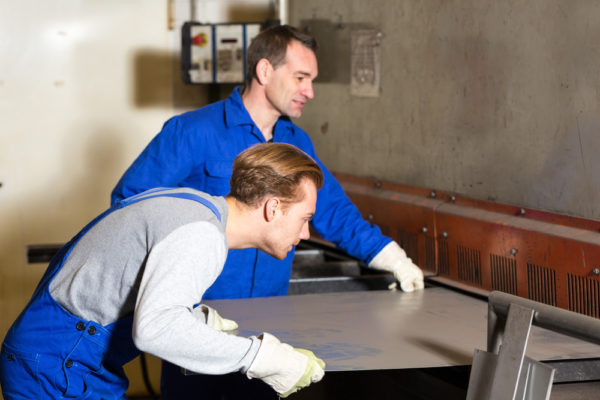
6 Things You Probably Didn’t Know About Sheet Metal

Sheet metal is a piece of metal that can come in varying thickness’ and cover a wide range of metals such as titanium, aluminium and steel. Sheet metal is used with industrial machinery and has many other practical applications. It is used on the wings of aeroplanes, car bodies and also as a material for roofs. Sheet metal actually has a pretty interesting history though. So, here are 6 things you probably didn’t know about sheet metal.

1.    No matter the type of metal, the construction process is the same

Sheet metal can be made from:

  • Aluminium
  • Steel
  • Copper
  • Brass
  • Nickel
  • Tin
  • Copper
  • Sterling Silver
  • Titanium

The process for creating sheets from all of these types of metals is the same. The metal is first melted and then poured into a mould where it can cool and take the shape of an ingot. It is important for the metal to be kept hot as it is being poured so it doesn’t cool outside of the mould.

Once it has cooled, it is dipped into some chemicals which clean the metal – a process known as pickling. It is then rolled repeatedly by a large press. The press will then heat up the metal in what is called the annealing process, whilst still rolling over it. Once the desired thickness is reached the sheet is ready to be shipped out.

2.    They come in varying thickness’

Whilst this may seem like an obvious one, there are certain parameters that sheet metal thickness follows for it to be useable. These are identified as gauges, and each sheet metal size has a different gauge. The gauge number doesn’t have any relation to the actual size of the thickness but is simply an industry standard for identifying them.

There are different gauges depending on the types of metals being used. For example, a 10 gauge of steel sheet metal is different from a 10 gauge of aluminium sheet metal. This is due to the fact that the gauges, whilst they identify the thickness of the sheet – the higher the gauge the thinner the sheet – they’re determined based on their weight. So, an aluminium sheet may be the same thickness as a steel sheet, but they would weigh differently.

3.    Sheet metal is not a modern marvel

Whilst it may seem like something that is only a few hundred years old, the reality is that sheet metal has been manipulated by sheet metal machinery for thousands of years. In fact, the earliest known use of sheet metal is from around 4,000 B.C when people would use large stones to roll the metal into their desired shape. The ancient Egyptians used sheets of gold and silver to craft magnificent jewellery for themselves.

A historic and iconic use of sheet metal is the construction of armour and weapons. It wasn’t until the 1400s where Leonardo Da Vinci designed a device capable of rolling sheet metal that the industry took a huge leap. This device was not properly completed until 1590 however, after Da Vinci’s death.

4.    Decorative sheet metal exists

Whilst you can find the most common type of sheet metal to work with listed above, there are also decorative, softer materials such as gold, platinum and silver that can be made into sheet metal. For obvious reasons these are not very common and are not generally not used in the same industries the more run-of-the-mill metals are used in. These are instead used for adornment purposes and cost quite a bit more.

5.    Sheet metal is responsible for other industry inventions

It’s true! Sheet metal machinery such as press brakes and hydraulic press’ were created for the express reason of being used with sheet metal. Whilst a press brake is used to bend sheet metal, a hydraulic press applies pressure to sheet metal in order to compress it. The first press brake was created around the mid-1600s, whilst the hydraulic press first came into existence in 1770 thanks to Industrialist Joseph Bramah.

6.    Sheet metal is in its own category

Sheet metal is actually classed as a medium thickness metal, typically ranging from .2mm to 6mm in thickness. Foil – or leaf – metal is the thinner sheet, which is anything under .2mm. The thickest of the three is plate metals and are predominantly 6mm or thicker.

Looking for sheet metal machinery?

ACRA Machinery is the only place you’ll need to find both new and used sheet metal machinery. Whatever your needs are, we offer a range of services and products to satisfy all your sheet metal machinery needs.

If you’d like to know more about our quality sheet metal machinery, then please give us a call on 03 9794 6675 or send us a message through our website.

What Are The Different Types Of Welding Techniques?

A weld is a useful and practical machine tool that has been around for many decades in one form or another. In our last blog, we spoke about what welding is and some interesting facts about the art. Today, we’re going to have a look at some of the welding techniques that are used in the industry and what makes them so unique.

Metal inert gas welding (MIG) or gas metal arc welding (GMAW)

Considered one of the easier types and common introductory technique for beginners, metal inert gas welding (MIG) – also known as gas metal arc welding (GMAW) – is suited for welding stainless-steel, mild steel and aluminium.

The process is fairly simple – a wire that is being constantly charged by an electrode current is fed through your weld to the two pieces of metal you wish to fuse. A shielded gas then runs along the wire to heat up the two metals, fusing them into one.

Shielded metal arc welding (SMAW)

This technique is a very basic and common technique. Whilst it is still considered a little trickier than MIG welding, it is a much smaller welding machine and can be picked up for use in a home environment – provided the proper precautions and safety measures are taken.

SMAW is alternatively known as stick welding. The stick uses electric current to form an electric arc that joins the two pieces of metal together. This technique is great for welding iron and steel sheet metal together, as well as general repair, construction and manufacturing purposes.

Tungsten inert gas (TIG) or Gas tungsten arc welding (GTAW)

Sometimes referred to as micro or precision welding, tungsten inert gas (TIG) is the process of melting the base sheet metal using the welding machine, and then fusing it together with the second piece of metal. This is done by superheating a very precise area using a tungsten electrode.

Most common metals can be welded together using this technique, but it is worth noting that this is probably the most difficult and time-consuming technique. This is a fairly new technique and is used for small-scale tasks predominantly. One of the notable features of this technique is that because it is so precise it usually does not require any extra clean-up –such as sanding – because it is not meant to leave any mess or residue.

Plasma arc welding (PAW)

Just like TIG, Plasma arc welding utilises a tungsten electrode, which is held inside the nozzle and acts as a constrictor. Plasma gas is then ionised within the nozzle and – due to the constrictions from the electrode – exits the nozzle at high speeds. Plasma arc welding has a high heat input, meaning the affected weld zone is quite wide – which may be considered an advantage or disadvantage depending on what you’re going for.

Electron beam welding (EBW)

This technique is quite a bit different from the more traditional ones we’ve been looking at. A high-speed stream of highly focused electrons from the welding machine bombards the sheet metal and superheats it via kinetic energy, allowing you to fuse the two desired pieces together.

This ultra-high energy beam allows for both a widely affected area as well as a small one for great precision. A vacuum setup is required to remove any possible gas related contaminations as well as to control the diameter and flow of the electron beams accurately.

Laser beam welding (LBW)

LBW is a very fast technique where the base metal is continuously blasted by a focused beam of photons. Because the concentrated photon beam can bring the sheet metal to its liquid state rapidly, the beam itself does not need to be sustained for very long and also has a smaller affected zone.

There are a few different output methods that LBW uses such as continuous waves and pulsing waves. The continuous wave – as mentioned before – can heat sheet metal very quickly and therefore doesn’t need to be used for very long. The pulsing wave does take a little longer but allow the metal to cool in between pulses – which can be useful if you’re fusing together a heat-sensitive metal.

Looking for sheet metal machine welders?

ACRA machinery has a large range of new and used sheet metal machine products including used welders. We supply a range of services and high-quality sheet metal machine solutions for all your needs.

If you require any further assistance with sheet metal machine products or information on welding then please do not hesitate to call us on 03 9794 6675 or contact us through our website here.

6 Facts About Welding

Welding is a process that involves connecting two pieces of metal together. It uses extreme heat – and occasionally additionally metals or gases – to solder two separate pieces together to become one. There are multiple different welding methods such as spot welding, shielded metal arc welding and gas tungsten arc welding.

These are only a few popular types of welding techniques that are used today. Welding can be used in conjunction with sheet metal machinery to alter sheet metal into a desired shape or variation. Our sheet metal machinery experts have put together a list of facts about welding that you might not know.

1.    It’s a 4000-year-old process

Circular boxes have been discovered that date back to the bronze age – approximately 2000 BC – that were created by hammering two pieces of metal together to form the single component. An early incarnation of what we call welding today.

2.    Robots have a history of welding

In 1961, the Unimate was installed at a General Motors factory. The Unimate was the world’s first industrial robot and its job was spot welding on an assembly line. The robot itself was basically just a giant arm that weighed around two tonnes and followed commands that were stored on a large magnetic drum.

3.    Welding can be done underwater

Whilst this is considered to be a very dangerous occupation, welding can actually be done underwater. There are a couple of ways this can be done. In an ideal situation, a dry chamber is used – in which a temporary hyperbaric chamber is set up to prevent water from entering the workspace. Oxygen is constantly monitored and replaced by another crew to keep the working conditions safe and minimise the effects of the welder being affected by the pressure.

The other option is the more dangerous of the two and is known as wet welding. Wet welding uses an electric arc as its source of energy. A thick layer of bubbles is created whilst welding due to the flux on the outside of the rod evaporating. This shields the weld from oxidising compounds and the water.

This is considered to be a temporary or last resort technique as there is often very little visibility whilst performing wet welding. In addition to this, a hazard known as Delta P– otherwise known as differential pressure – can be a fatal hazard to wet welding divers. There is really no way of detecting Delta P’s until it is too late, making them all the more dangerous. When two bodies of water intersect – each of them holding a different level of pressure – it can potentially drown anyone who is caught in between.

4.    Metals in space automatically weld upon contact

Believe it or not, it’s true. It’s a process known as cold welding. Anytime two pieces of metal in space come into contact with each other, they instantly weld themselves together creating one piece. This will only apply to metals without any coating on them – so either bare or highly polished metals. This is a phenomenon that cannot happen on Earth however because our atmosphere creates a layer of oxidisation between two metals. It is this lack of oxidisation layer that causes cold welding to occur in space.

5.    Welding advanced during the second world war

Gas tungsten arc welding (GTAW) was an idea to weld in a non-oxidising gas atmosphere. It was patented in 1890 by C.L. Coffin. This concept was refined by H.M. Hobart and P.K. Devers in the 1920s who used helium and argon, respectively, for shielding. But it wasn’t until 1941 when it was patented by Meredith, that it was perfected. GTAW is now a popular – yet complex – welding technique that uses a tungsten electrode to produce the weld.

The SS Robert E Peary was a ship built in 1942 that only took 4 days, 15 hours and 27 minutes to complete. This was the record for the fastest built ship in the world, and the record still stands today. The ship operated in the Pacific and Atlantic oceans before it was scrapped in 1963.

6.    NASCAR cars need a lot of welding

If you added up all the time welding is used on a NASCAR car before it hits a track it would amount to over 950 hours. Every part of a NASCAR car from the suspension through to the drive train is welded together to meet the NASCAR standards required.

Need a welder?

Here at ACRA we supply all sorts of machine services as well as industrial equipment from used welders to sheet metal machinery. With experienced and passionate staff, we’re ready to help you with any welding or sheet metal machinery questions you may have.

If you have any further questions regarding our equipment or maintenance requirements, please do not hesitate to give us a call on 03 9794 6675 or send us a message here.

Laser Cutting The Safe Way

Laser cutting is the process of cutting metal using a very hot and concentrated laser beam that melts the metal. Because it is such a concentrated beam over a small target area, this process is very precise and is most effective against mild steel, stainless steel and aluminium plates. It is a very popular and fast way of cutting sheet metal but can be dangerous if you don’t know what you’re doing. Here are some safety procedures to follow and look out for the next time you plan on using a laser cutter.

Making sure the machine is clean

Before you begin cutting anything you should thoroughly check that the machine is clean, and everything is in working order. Because the laser produces such high levels of heat through its concentrated beam, there is always a big fire risk when working the machine. Unwanted dirt and grime built up in the machine can contribute to accidental fires breaking out.

This also applies to the materials being cut. Sometimes the extremely high temperatures can cause unwanted fires. It is because of this that the operator should never leave the machine during operation in case something like this happens. It is important to standby at the ready in case a fire needs extinguishing or in case of any other emergency.

Filtering fumes

If you use a laser cutter then toxic fumes will be released during the cutting process. You should make sure your laser cutting machine has an air filtration/exhaust system fitted. The filter will need to be changed regularly depending on how often the machine itself is used. If the filtration system is damaged, clogged or not working for any reason, then stop immediately and notify your supervisor. Never attempt to work a laser cutting machine when parts are not working.

This being said, the air filter/exhaust can only do so much against the external forces of the system – such as the plastic/metal/material you’re actually cutting – so extra precautions will need to be taken. You must always make sure you cut materials that have been approved by the manufacturer and are not hazardous. Fumes from hazardous plastics can be harmful to the machine and to your own health.

The light from the laser

As well as emitting high temperatures, the laser beam also emits a very bright light which can cause severe damage to your retinas, resulting in serious damage to your eyesight or even blindness. Skin burns are another symptom that can be a result of exposure to the laser beam light. This is why the light is always contained within the safety glass and shut together with interlocks.

Laser cutting machines come with a standard safety feature where the beam cannot operate if the interlocking mechanism is not closed and locked into place. This is why it is important to never change the safety features. As long as the beam is properly contained, it is less likely to escape and cause you any light-related injuries. In Australia (and other countries), laser beams are categorised into seven different classes: 1, 1M, 2, 2M, 3R, 3B and 4 – where 1 is the least hazardous and 4 is the most.

Cleaning the machine

As mentioned earlier, dirt and debris can cause fires and also damage the machine if not cleaned away, so it is important to make sure the machine is clear of these things on a regular basis. It is recommended you use a vacuum for this sort of thing. If you need to use liquid cleaning materials, do not spray them directly onto the machine. Spray them onto a cloth away from the machine and then gently use the cloth to clean the outside and inside of the machine. The operations manual for the machine should outline which cleaning products are appropriate to use.

The mirrors and lens should be cleaned once a week at the minimum, if there appears to be more dust than usual then more frequent cleaning may be required. Optics of the machine should be visually inspected once a day. If the optics appear to be cloudy or if there are small amounts of dirt found on them then again, refer to the manual – or your supervisor – on how to best clean them. The optics should be cleaned very carefully and gently as they can be damaged if done in excess.

Quality laser cutters

Acra Machinery is a Dandenong based company specialising in many types of machinery as well as new and used laser cutting devices.

If you need any assistance with laser cutters or any other machines, please contact us on 0397 946 675 or through our website.